 |
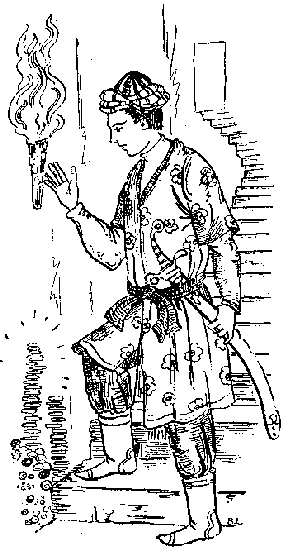
Prince pengar & the genie
|
Once upon a time there was a king of Persia who had
one son, called Prince Pengar.
The old king died, and as Prince Pengar was still young, his mother ruled over
the kingdom.
The young Prince was very kind-hearted and he gave a great deal away to the
poor. Sometimes his mother reproved him for his generosity, but he always said:
"Oh Mother, why are you so uneasy? We are rich and will always have
plenty."
However, the little prince was so generous that at last he gave away all they
had, and he and his mother became very poor.
One night Prince Pengar was asleep, and he dreamt that a genie came to
him. The genie told him to go to a certain place, to lift up a large stone that
he would find there, and to dig up the treasure that lay beneath.
 |
They set off together through the air, thanks
to the magical powers of the hermit, and soon came to the edge of the genie’s
kingdom.
The hermit threw the barrel top onto the ground,
and he and the Prince stepped onto it. Almost immediately the genie arrived, and
invited them to come to his palace, where he could give them a proper welcome.
"Oh no," said the hermit. "We will
not leave this circle, where, as you well know, we have every right to be, until
you bring us the ninth statue, belonging to the ninth pedestal in the King of
Persia’s treasure room."
"With all my heart," said the genie,
"but first you must find a maiden who has not only never done any wrong,
but has never even thought of doing so."
"Where shall we find such a wonder?"
"Take this looking-glass," said the
genie. "Give it to all the maidens in Persia, and if you find one whose
breath does not tarnish the glass, bring her to me, and I will take care of the
rest."
The hermit took the looking glass from the genie
and they returned by the way they had come.
When he got home, Prince Pengar announced
throughout the kingdom that he wished to marry, and that all the maidens were to
come to the palace.
Soon a crowd of girls arrived, some rich, some
poor, some ugly, some beautiful, for all were invited.
When they arrived, each maiden was told to look
into the looking glass, and to breathe upon it.
No one, be they ever so beautiful or rich, could do
so without tarnishing the glass, and Prince Pengar began to despair, for almost
every maiden had been tested, and none had succeeded. At last someone told him
of two sisters, who were living in great seclusion in a little village. They
were young, and rich, and beautiful, and they had not, as yet, come to the
palace.
Prince Pengar gave orders for them to be brought
and they soon arrived at the court. The two sisters were certainly very
beautiful, and they were also very shy, for they had never been into the world
before.
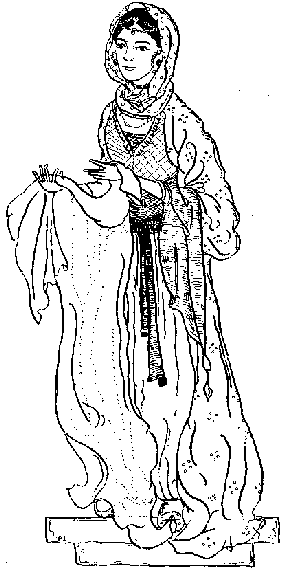
First the elder sister was given the looking glass.
She breathed upon it, and tarnished it ever so faintly, but much less so than
the other girls. Next it was given to the younger sister. She also breathed upon
it, but her breath did not leave the faintest mark.
"At last!" cried the Prince. "This
is she whom I have been seeking, and no one else shall be my wife."
He and the hermit returned to the genie, and showed
him the maiden they had brought with them.
"Yes," said the genie. "This is the
wise and pure-hearted beauty that you had to find. Now, give her to me and
return to your palace. Go down into the treasure room, and you will find the
ninth statue on the ninth pedestal. Prince Pengar will thus have fulfilled all
the conditions, and will be able to enjoy the vast wealth amassed by his
father."
The Prince did not want to give the maiden to the
genie, but the hermit assured him that all would be well, and they returned
together to the palace.
They entered the underground cavern, and saw the
eight statues as before. Upon the ninth pedestal stood a shape that looked
something like a woman, wrapped in a long, thick veil. The hermit told the
Prince to pull off the veil; and when he did so, he saw to his joy that the
pure-hearted maiden stood beneath, dressed in all the finery of a bride. He gave
her his hand, and she smiled at him, and stepped down off the pedestal. The
Prince presented the maiden to his mother, and the betrothal was celebrated
immediately.
The wedding took place eight days later, and there
was much public rejoicing, and many festivities, to which both the poor and the
rich were invited.
The genie and the hermit were also there, and they
forgave each other, and became friends once again.
The hermit even gave up the circle of land which he
had won from the genie, as a token of thanks for all he had done for Prince
Pengar.
Retold from a Breton story © 2006 Bethan Lewis