The Miller’s Boy & the Little Cat
The Miller’s Boy and the
Little Cat is from the Brothers Grimm collection of fairy stories.
Once upon at time there lived an old Miller
who had neither wife nor children. Three miller’s boys worked for him, and
when they had been with him for several years he called them together and said:
"I am old, and want to sit
behind the stove. Go forth and whoever brings me home the best horse shall have
my mill, and in return he shall care for me until my death."
However, the third miller’s boy was
regarded as a simpleton by the other two, and they did not want him to ever have
the mill.
All three set out together and when
they came to the village, the two older apprentices said to Simple Hans:
"You might as well stay here; in all your life you will never find a
horse."
Still, Hans went on with them, and
when night fell they came to a cavern, in which they lay down to sleep. The two
clever ones waited until Hans was asleep, then they climbed out, and hurried
away, leaving little Hans where he was. And they thought they had done a clever
thing, but it was bound to turn out badly for them in the end.
When the sun came up and Hans awoke,
he found that he was lying in a deep hole; he looked all about him and cried:
"Dear God, where am I?"
then he got up and crawled out of the cave. He went into the forest and thought:
"Here I am, all alone and
forsaken, how shall I find a horse now?"
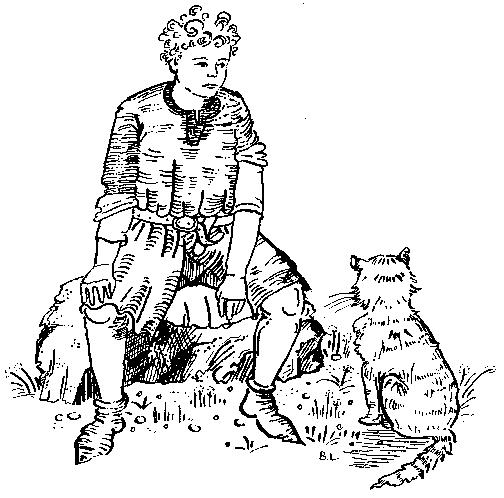
As he was walking along, thinking in
this way, he met a little tabby cat, who said kindly:
"Hans, where are you
going?"
"Alas you cannot help me."
"I know what your wish is,"
said the little cat. "You want to have a beautiful horse. Come with me, and
be my faithful apprentice for seven years, then I will give you the most
beautiful horses you have ever seen."
"Well, this is a very strange
cat," thought Hans. "But I will see if what she says is true."
The Cat took him to her enchanted
castle and it was full of kittens who waited on her. They leapt nimbly up and
downstairs and were merry and full of spirits.
In the evening, when they sat down to
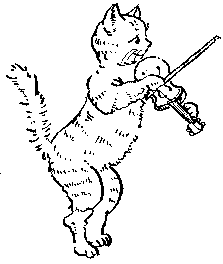
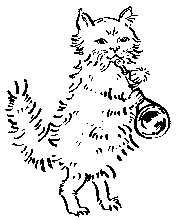
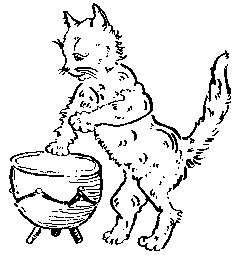
dinner, three of them had to provide the music; one played a bass-viol, another
the fiddle, and the third put the trumpet to its lips, and blew out its cheeks
as much as it could.
When they had dined, the table was
carried out and the Cat said:
"Now come, Hans, and dance with
me."
"Nay," he replied. "I
will not dance with a pussy cat. That is a thing I have never done."
"Then take him to bed," she
said to the kittens. So one carried a candle up to his bedchamber, another took
off his shoes, one took off his stockings, and, finally, one blew out the light.
Next morning they came again and
helped him out of bed; one put his stockings on for him, one tied his garters,
one brought his shoes, and one washed him and dried his face with its tail.
"That is very soft," said
Hans.
He, however, had to wait on the Cat,
and every day he had to chop up wood for kindling: for that he received a silver
axe, and the wedge and saw were also of silver and the mallet was of copper.
Time passed, and Hans chopped wood,
lived in the house, and had good food and drink, but he saw no one save the
tabby cat and her servants. One day she said to him:
"Go out and mow my meadow, and
dry the grass." She gave him a scythe of silver and a whetstone of gold,
but she asked him to take care to return them safely.
Then Hans went forth, and did as he
had been ordered; when the work was done, he carried the scythe, the whetstone
and the hay to the house and asked if it was not time to give him his reward.
"No," said the Cat.
"You must first do something else of the same kind. There is silver timber,
a carpenter’s axe, a square and everything necessary, all made of silver. From
these, you must build me a little house.
So Hans built the little house and
said that he had now done everything, and yet he still had no horse. Yet the
seven years had passed by as if they were half that time. The Cat asked if he
wanted to see her horses.
"Yes," said Hans. She
opened the doors of the little house and when the doors were open he saw twelve
horses, and – oh – they were so proud and so bright and shining that his
heart leapt in delight.
The cat gave him something to eat and
drink, and said:
"Go home, I will not give you
your horse now – in three days I will come and bring it you."
So Hans set out and she showed him
the way to the mill. However, she had never once given him new clothes and he
had to wear the old dirty smock which he had brought with him, and which during
the seven years had everywhere become too small.
When he came home, the two other
miller boys were also there; each of them had brought a horse with them, but one
was blind and the other lame.
They asked: "Hans, where is your
horse?"
"It will follow on in three
days."
At that, they laughed and said:
"Oh yes, to be sure. Hans, where will you find a horse? That would be a
fine animal indeed."
Hans went into the parlour but the
Miller said he could not sit down to the table, for he was so tattered and torn
that they would be ashamed if anyone came in.
They gave him a mouthful of food
outdoors and when they went to rest in the evening, the other two would not let
him have a bed, and in the end he had to creep into the goose-house, and lie
down on a little hard straw.
In the morning, when he awoke, the
three days had already passed, and a coach arrived with six horses that shone
so, that it was wonderful to see them; and a servant was bringing a seventh,
which was for the poor Miller’s boy.
Out of the coach stepped a
magnificent princess and she went into the mill, and this princess was the
little tabby-cat, who poor Hans had served for seven years. She asked the Miller
where the third apprentice, the simpleton was.
The Miller said: "We cannot
bring him into the mill, he is so tattered – he is lying in the
goose-house."
The Princess said that they must
bring him at once. So they brought him out, and he had to hold his little smock
together to cover himself. The servants unpacked some splendid clothes and
washed and dressed him, and when he was ready, no king could have looked more
handsome.
The maiden asked to see the horses
that the other miller’s boys had brought, and one was blind and the other
lame.
Then she ordered the servant to bring
the seventh horse; and when the Miller saw it, he said that such an animal had
never yet entered his yard.
"And that is for the third
miller’s boy," she said.
"Then he must have the
mill," said the Miller. However, the Princess said that he could keep the
horse, and he could also keep his mill, and she took her faithful Hans and sat
him in the coach, and drove away with him.
They drove first to the little house
that he had built with the silver tools, and, lo, it was a great castle, and
everything inside it was of silver and gold. And then she married him, and he
was rich, so rich that he had enough for the rest of his life.
After this, let no one say that a
simpleton cannot do very well for themselves.
The End
Home